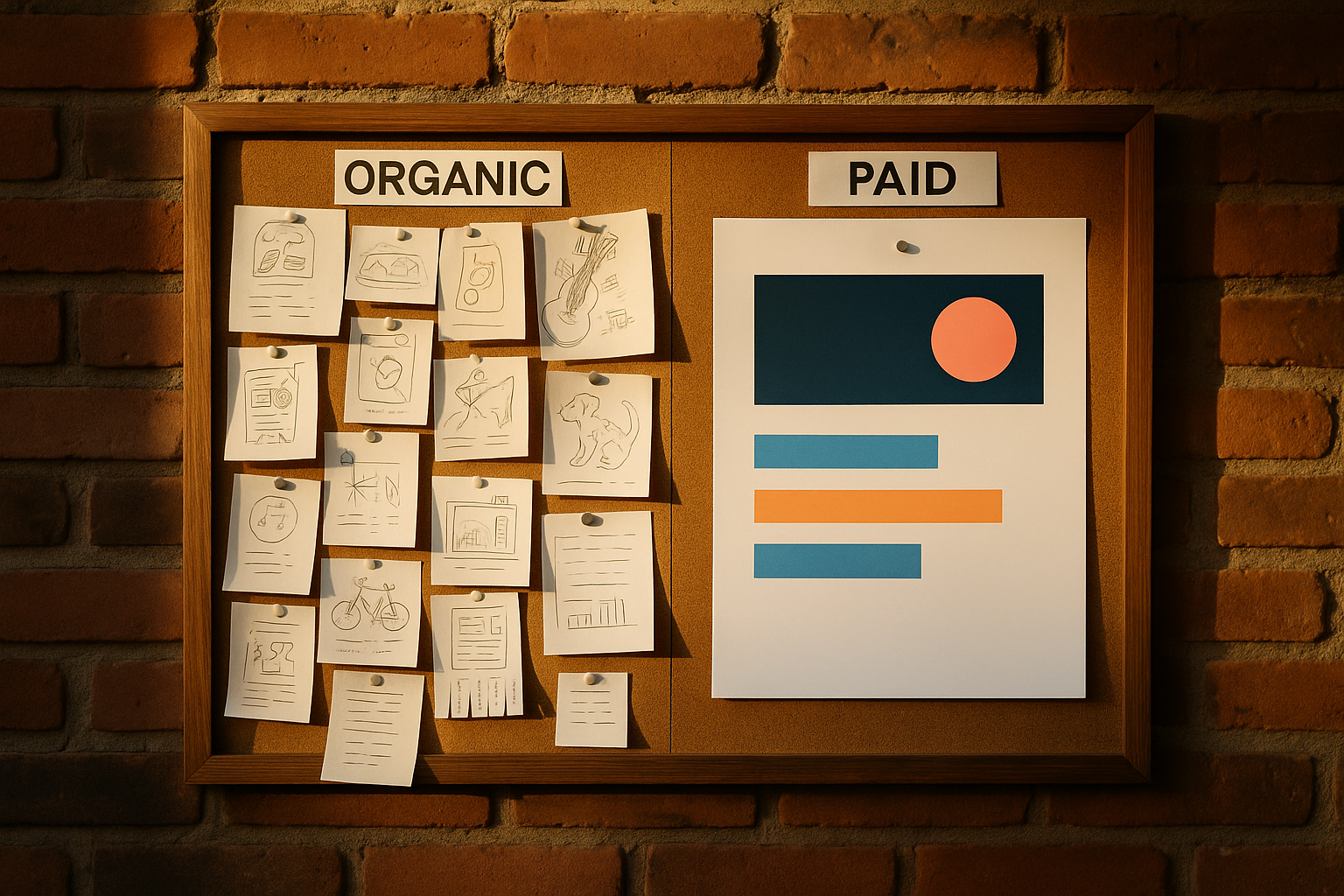
Organic social media is free content you post to build relationships over time. Paid social media is advertising you pay to place in front of a targeted audience — right now. Neither one alone is a complete marketing strategy for a small business. The real question isn't which one to pick; it's understanding how each engine runs so you can use both wisely.
What Actually Is Organic Social Media, and What Does It Cost You?
Organic social media is every post, reel, story, or comment you publish without paying to promote it. It costs zero ad dollars — but it is never truly free. Your time, your energy, and the consistency required to do it well are the real price of admission.
For a salon owner or solo contractor, that means carving out time to photograph your work, write captions, respond to comments, and show up week after week. Organic content builds trust, personality, and community. But it reaches people slowly — largely limited to those who already follow you or stumble onto your profile through hashtags or shares.
A verified finding from Sprout Social's research is worth noting here: average organic reach dropped by around 62% between 2020 and 2023, citing a study from Demand Curve. Platforms prioritize paid content in the feed, which means posting great content is necessary but no longer sufficient on its own.
What organic social includes:
- Regular posts (photos, videos, carousels)
- Stories and reels
- Responding to comments and DMs
- Sharing customer reviews or user-generated content
- Engaging with local community pages or groups
What Is Paid Social Media, and How Does It Work?
Paid social media means you pay a platform — Meta (Facebook and Instagram), YouTube, or others — to show your content to a specific audience, whether or not those people follow you. You set a budget, define your audience by location, age, interests, or behavior, create an ad, and the platform delivers it.
The mechanics are straightforward: you bid for impressions or clicks, and the platform's algorithm decides when and where your ad appears based on relevance and bid. You only spend when your ad runs, and you can pause or adjust at any time.
For Meta Ads specifically, that targeting precision is one of the most powerful tools a small business has access to — letting a local restaurant or service provider reach people within a five-mile radius who match their ideal customer profile.
How Are Organic and Paid Social Different in Reach, Speed, and Targeting?
The core difference between organic and paid social media comes down to three things: who sees it, how fast, and how precisely.
| Factor | Organic Social | Paid Social |
|---|---|---|
| Cost | No ad spend; costs time | Requires budget |
| Reach | Mostly existing followers | Anyone you target |
| Speed | Builds slowly over months | Delivers results immediately |
| Targeting | Limited (hashtags, shares) | Precise (location, age, interests, behaviors) |
| Lifespan | Posts can resurface over time | Active only while budget runs |
| Trust signal | High — feels authentic | Lower — clearly labeled as an ad |
| Analytics | Basic engagement metrics | Detailed conversion and ROI data |
Organic is a long game. Paid is a lever you can pull today.
Which One Should a Small Business Use First?
Start with organic — but don't wait long before adding paid. Here's why: organic content gives you proof of life. Before you spend a dollar on ads, you want a profile that looks active, professional, and trustworthy. If someone clicks your ad and lands on a ghost town of a page, your ad dollars are wasted.
Once your profile has a baseline of real content — even a dozen posts that show what you do and who you are — paid advertising amplifies that foundation. You're no longer asking strangers to trust a blank slate; you're driving them to a page that already builds credibility on arrival.
A practical sequence for most small businesses:
- Set up your profiles and post consistently for several weeks to build a foundation
- Identify what content gets real engagement — that's your creative signal
- Launch paid ads targeting your local audience with a clear offer
- Use ad performance data to improve both your paid campaigns and organic content
What Can Paid Ads Do That Organic Simply Cannot?
Paid social gives you three capabilities that organic never will: instant reach, precise targeting, and measurable ROI.
You can launch a campaign today and have your offer in front of hundreds — or thousands — of local prospects by tomorrow. You can target people by ZIP code, household income, recent life events, or purchase behavior. And you can track exactly how many people clicked, visited your site, or converted.
A real example: Drummond Studio Gallery (Charleston, SC) ran ad campaigns in May 2026 and generated $3,725.16 in ticket revenue on just $425.80 in ad spend — an 8.7x return on ad spend, with 125 tickets sold and one sold-out event. That kind of traceable, immediate result is simply not possible through organic posting alone. You can explore more examples on the SCPM Media case studies page.
Paid ads also give you the ability to retarget — showing follow-up ads to people who visited your website or engaged with your page but didn't convert. This is a powerful tool for service businesses with longer consideration windows.
What Can Organic Content Do That Paid Ads Cannot Replace?
Organic content builds something paid ads cannot buy: genuine trust over time.
A verified insight from Sprout Social's research references a Stackla study finding that 79% of respondents favored user-generated content when making purchasing decisions, compared to 13% who favored branded content. Authentic, real-world content — customer photos, behind-the-scenes reels, honest reviews — carries social proof that no paid placement can manufacture.
Organic content also:
- Builds community around your brand through comments and conversations
- Establishes expertise when you share tips, processes, or results consistently
- Lasts longer — a strong post or reel can resurface through shares and saves long after it's published
- Costs nothing to amplify when customers share it organically
For local businesses, this trust layer is often the difference between a prospect choosing you or a competitor. See how creative production can raise the quality of that organic content without requiring a full content team.
How Do the Two Work Together as a System — Not a Choice?
The best-performing small business marketing doesn't treat organic and paid social as a binary decision. They function as two engines in the same machine.
Here's the practical loop:
- Organic content tests what resonates with your existing audience at zero ad cost
- Paid ads pour fuel on the content and offers that already perform
- Ad performance data tells you what messaging, visuals, and calls-to-action are working
- That insight feeds back into better organic content — and better future ads
Think of organic as your always-on brand presence and paid as your precision growth tool. A local contractor who posts weekly job site photos builds trust — and then runs a targeted ad to homeowners in their service area whenever they have open slots to fill. The two efforts reinforce each other constantly.
The 2025 Sprout Social Index™ found that 75% of marketing leaders rank paid and organic social media as top priorities — not one or the other. That's a signal worth taking seriously, even at the small business level.
What Does a Realistic Budget Look Like for Paid Social as a Small Business?
Paid social doesn't require a large-agency budget to produce real results. What it does require is intentional spending — putting dollars behind the right audience, offer, and creative rather than boosting posts randomly.
SCPM Media's verified case study for a Thai restaurant in the Summerville, SC area shows what a sustained, modest budget can accomplish: $5,200 in total ad spend over 12 months (October 2024 through September 2025) generated 910K+ impressions and 19,418 ticketing clicks, with a peak click-through rate of 10.26%. That works out to a manageable monthly average — an accessible investment for most local businesses.
Key budget considerations for small businesses:
- Start small and test — even a limited daily budget generates data you can learn from
- Focus on one platform first — spreading thin across every network wastes money
- Tie spend to a specific goal — ticket sales, form fills, calls, not just "awareness"
- Track your cost per result — without this number, you can't optimize
SCPM Media campaigns are designed to launch within 5–7 business days, with no long-term contracts — so small businesses can test paid social without a long-term financial commitment. Let's Talk Growth if you want to explore what a realistic budget could accomplish for your business.
Common Mistakes Small Businesses Make When Choosing Between the Two
Most small businesses don't fail at paid social because they picked the wrong platform. They fail because of avoidable strategic errors.
Mistake 1: Running paid ads with no organic foundation A live ad that sends traffic to an empty or outdated profile kills conversion before it starts. Build credibility first.
Mistake 2: Treating every post as an ad Boosting random posts without a defined audience or conversion goal burns budget with no measurable return. Boost strategically, not reflexively.
Mistake 3: Going all-in on organic and expecting fast growth Organic reach has been declining across every major platform for years. Expecting viral results from posting alone is a slow path with an uncertain destination.
Mistake 4: Stopping ads the moment a campaign goes quiet Short-term thinking kills long-term momentum. Paid campaigns need time and data to optimize. Cutting them after a slow week is one of the most common and costly errors.
Mistake 5: Never connecting the two If you're creating organic content and running ads in separate silos, you're leaving performance insights — and efficiency — on the table.
Quick-Reference: Organic vs. Paid Social Media at a Glance
Use this as your go-to reference when deciding where to put your time and money.
| Organic Social | Paid Social | |
|---|---|---|
| Best for | Trust, community, brand voice | Reach, leads, fast results |
| Cost | Time and consistency | Ad budget |
| Speed | Slow (months) | Fast (days) |
| Reach | Existing audience | Any audience you define |
| Targeting | Minimal | Precise |
| Measurability | Engagement metrics | Conversions, ROAS, CPL |
| Longevity | Content can resurface | Active while budget runs |
| When to use | Always — it's your foundation | When you need results now |
The honest answer to "what's the difference between organic and paid social media" isn't about choosing a winner. It's about knowing what each tool does well — and building a simple system where both are working for your business at the same time.
If you're a small business owner ready to stop guessing and start running paid ads that tie back to real revenue, explore SCPM Media's full range of services or book a consultation to see what a done-for-you system looks like for your specific situation.
Frequently Asked Questions
What is the main difference between organic and paid social media?
Organic social media is content you post for free that reaches primarily your existing followers. Paid social media is advertising you pay for to reach a targeted audience beyond your followers — instantly and precisely.
Can a small business succeed with only organic social media?
It's possible but increasingly difficult. Organic reach has declined significantly across major platforms in recent years, meaning even great content may reach only a fraction of your followers. Most small businesses benefit from pairing organic content with even a modest paid budget.
How much should a small business spend on paid social ads?
There's no universal answer, but real results are achievable on modest budgets. A verified SCPM Media client case study shows a local restaurant generating 910K+ impressions and nearly 19,418 ticketing clicks on a total ad spend of $5,200 spread over a full year — a manageable monthly average for most local businesses.
Which should a small business start with — organic or paid?
Start with organic to build a credible, active presence, then add paid social once you have a baseline of content and a specific offer to promote. Running ads to an empty or inactive profile wastes budget.
How do organic and paid social work together?
They form a feedback loop: organic content tests what resonates with your audience at no cost, paid ads amplify what works, and ad performance data improves both your campaigns and your organic content strategy over time.